GIS personnel transport unit ensures safe access to the clarifier

Electric chain hoists and crane systems are versatile lifting tools that are used in various industries and applications to lift and move heavy machines, components and materials. However, the applicable regulations for cranes generally exclude the transportation of people. Chain hoist manufacturer GIS has recently introduced a new solution for the safe transportation of people based on the EN 1808 standard (safety requirements for suspended access equipment). This is type-tested, which is a requirement of the Machinery Directive 2006/42/EC, and has TÜV certification
Developed in collaboration with ARA Worblental
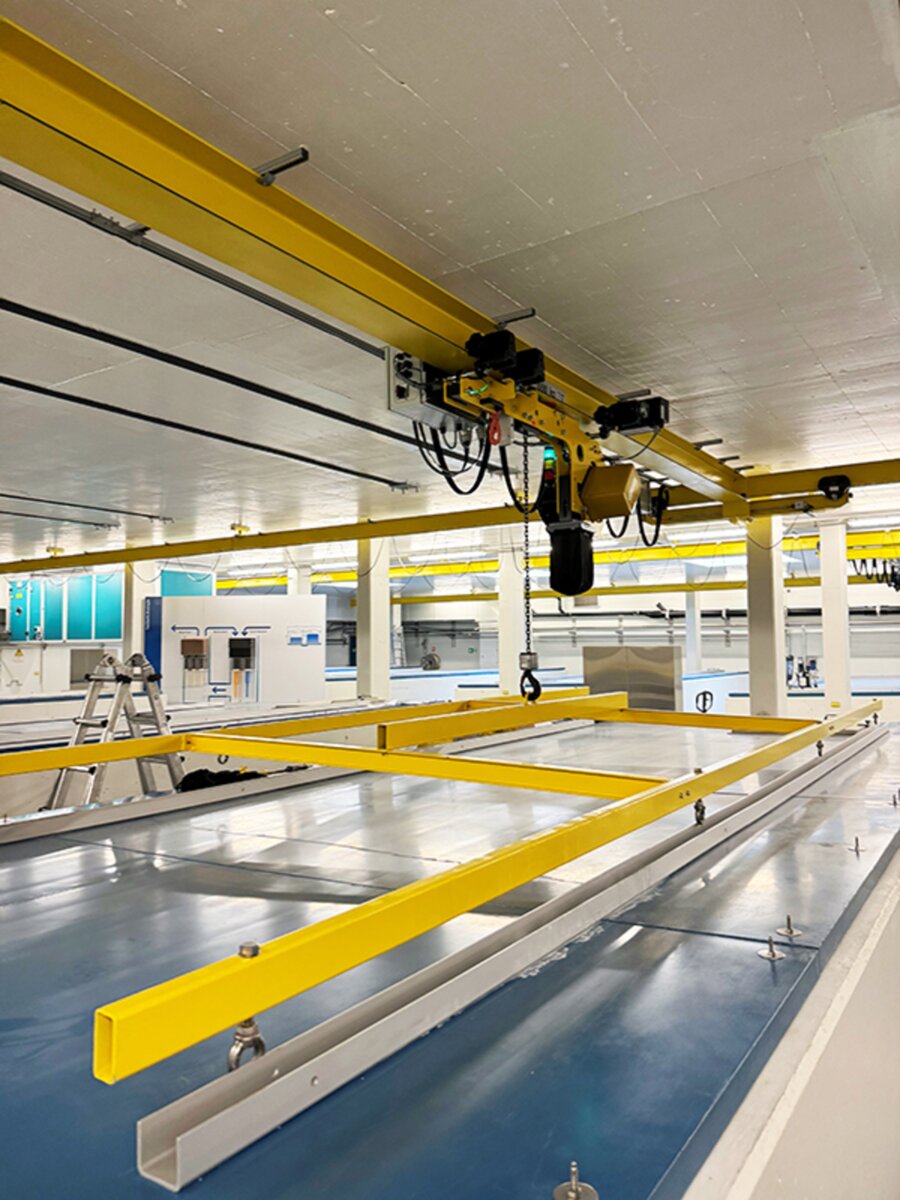
GIS AG developed the first crane system of this type for the third-largest wastewater treatment plant in the canton of Berne, the Worblaufen WWTP, in order to transport employees safely into the fixed-bed cells, which are up to 10 metres deep, to rectify faults. The area of the sewage treatment plant that includes the water treatment basins was already equipped with GIS travelling cranes. These were mainly used for transporting goods and for removing and installing the basin covers. With the clear requirement that the crane system can also be used for transporting people without a permit in addition to its use as a normal industrial crane, the existing hoist of the indoor crane was replaced with a new GIS GPK1000 electric chain hoist including trolleys.
From industrial crane to passenger transport unit
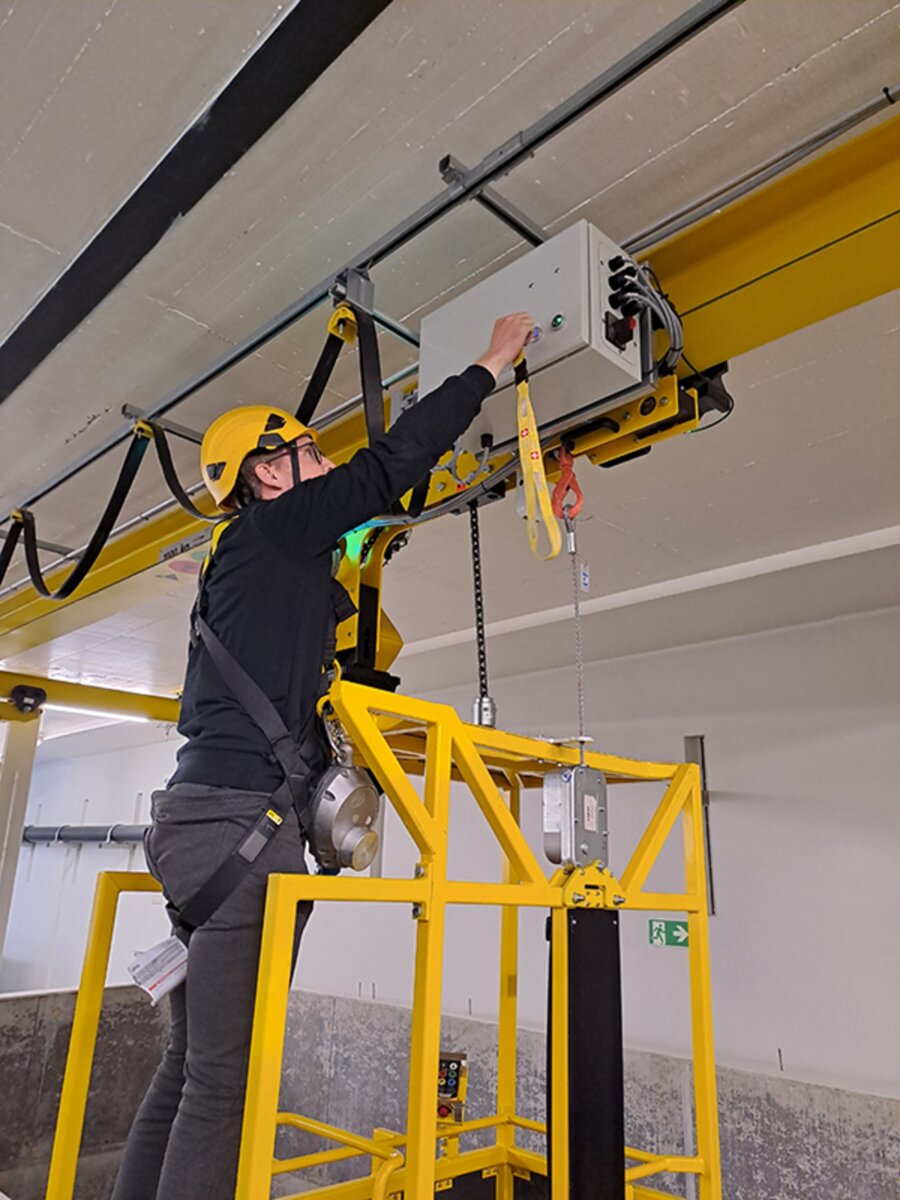
In case of need, the transport cage must first be attached to the chain drive instead of the load hook. This is a robust, welded steel cabin with a closed ceiling construction, which also protects the passenger from falling objects. In the next step, the operator connects the load securing device already pre-installed on the cage to the safety shackle of the hoist. In the unlikely event of the primary safety device, the chain hoist, breaking, this secondary safety device would limit the fall speed of the cage to 0.5 m/s and stop the fall. The steel frame of the cage has a holding device to attach it to the edge of the pool and allow the passenger to enter comfortably. Before the operator enters the cabin, they must put on their personal protective equipment and attach the fall protection device to the anchorage point provided. The crane system is then switched with the safety key from the normal state to the setup for passenger transport (PTA operating mode). The signalling column no longer lights up green for use as an industrial crane, but a yellow lamp signals the special mode for passenger transport.
The person in the passenger cabin is in control
The operator climbs into the cab and closes it behind him. In PTA mode, the crane is controlled by a hand-held transmitter permanently installed in the passenger cabin in accordance with the standard. This allows the passenger in the basket to manoeuvre to the desired position in the fixed bed. During the lifting and lowering processes, the safety control system continuously monitors the load. Unintentional unloading of the chain, for example as a result of uncontrolled positioning of the passenger transport basket on uneven surfaces or obstacles, combined with a dangerous inclined position of the cabin, is prevented by automatically stopping the movement.
Safe operation requires the presence of an additional person who observes the entire process from the edge of the pool. This person is also protected against falling with personal protective equipment. If the control unit in the transport cage fails, the observer connects a wired emergency control switch with quick-release fastener to an easily accessible socket and takes over control of the crane system. In the event of a power failure or other malfunctions, a comprehensive evacuation and safety concept is in place to ensure the safe rescue of the passenger.
Chain hoist for confined spaces with various safety elements
Due to the limited space between the edge of the basin and the ceiling, a GIS electric chain hoist type GPK1000 is used as the hoist for the Worblental WWTP. This was designed for use in environments with low ceiling heights and confined spaces. The chain outlet is not located at the bottom of the chain hoist, but is offset upwards by a metal frame. This allows important centimetres of lifting height to be gained. The latest generation of GIS motorised and manual trolleys are used for trolley travel on the crane girder.
Safety in accordance with EN 1808 is guaranteed over the entire load path of the hoist right up to the higher-level GIS travelling crane. It is controlled by the interaction of the regular crane control system and the additional safety control system. The safety functions of the control system comply with the EN 13849 standard and have also been type-tested by TÜV.
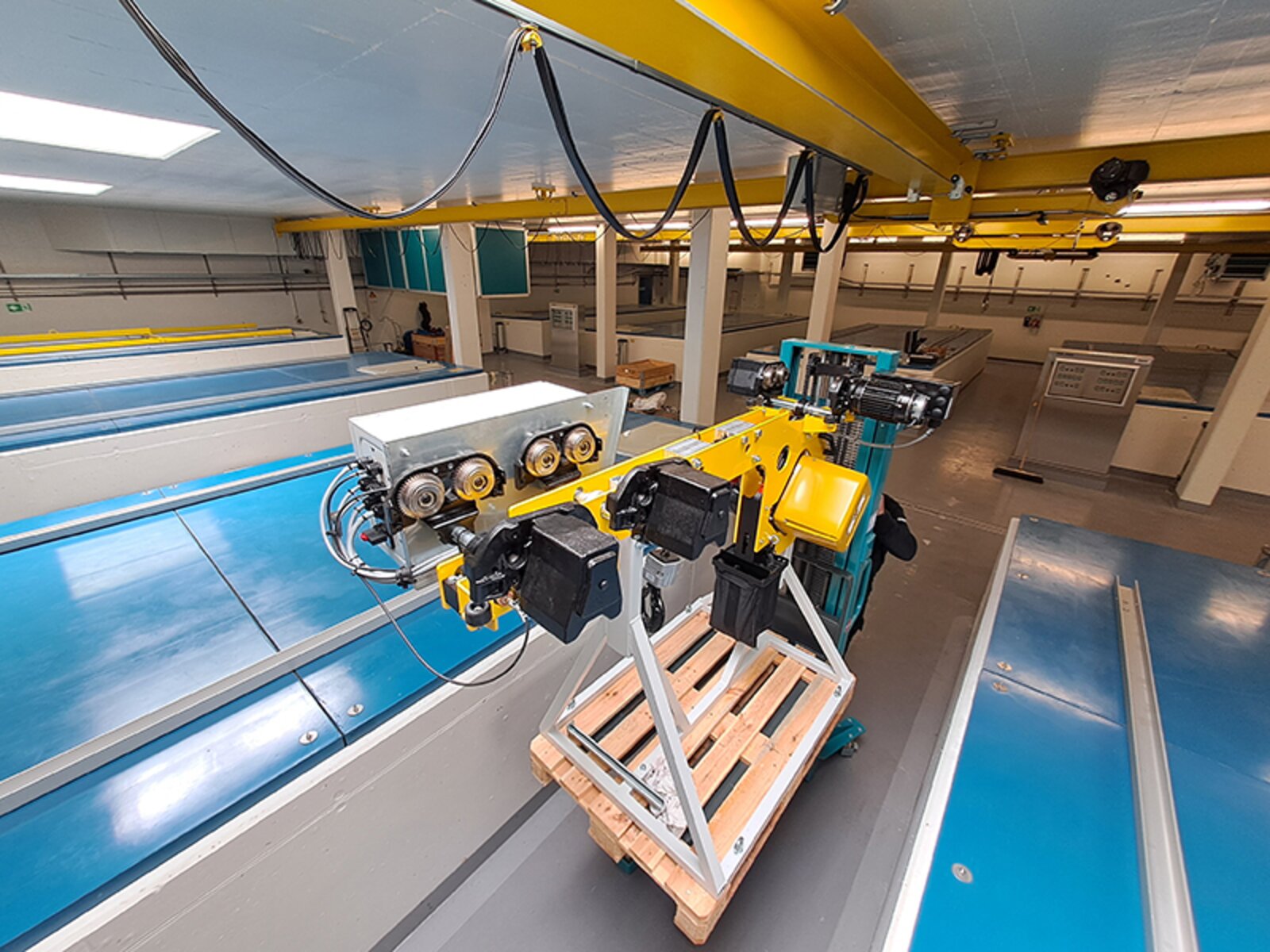
With the help of a special device, the lifting unit and trolleys can be quickly removed from the original crane girder, moved to another crane bridge in the hall using a high-lift forklift and reassembled there. In this way, the personnel transport unit can be used efficiently on several overhead travelling cranes, enabling access from above to a large number of clarifiers.
Technical data / fact sheet
- The overall system consists of a hoist (GP1000 or GPK1000 electric chain hoist), a GHF1250 manual trolley, a GMF1250 motorised trolley, a secondary safety device, a personnel transport cage and a superordinate suspension structure (in the case of the Worblental WWTP, this is an existing overhead travelling crane).
- Due to the limited space between the edge of the basin and the ceiling, a GPK1000 is used at the Worblental WWTP. This type of chain hoist was developed for tight spaces. The chain hoist has a chain for a lifting height of 11 metres.
- The overload protection of the electric chain hoist is provided by an indirect solution in accordance with the EN 14492-2 standard and fulfils the requirements for safety-related control systems (EN 13849). The load is detected by a load measuring pin integrated in the system. There is no direct load measurement in the form of a slipping clutch.
- The hoist motor is equipped with thermal overload protection. Further safety features of the chain hoist include a second brake as a secondary safety element in the event of failure of the normal holding brake and a gear limit switch with additional emergency shutdown if the normal limit switch is exceeded in exceptional cases. In passenger transport mode, a slack chain monitor is also active, which stops the lowering movement if the chain is unloaded in an uncontrolled manner.
- It is controlled by the interaction of the regular crane control system of the existing travelling crane and the additional safety control system attached to the hoist. The crane control unit is responsible for the overall crane movements, while the operating mode switchover, emergency stop functions, overload protection and slack chain monitoring are handled by the safety control unit. The operator uses the safety key to switch from normal operation to passenger transport mode. A signalling column indicates the operating status of the crane.
- The passenger basket for one person is a welded steel construction with a closed roof. Access is via an inward-opening door. The secondary safety device is already pre-assembled on the cage and is connected to the hoist or its running gear via a safety shackle.
- The passenger cabin has an anchor point for attaching the operator's personal protective equipment and an anchor point for attaching the rescue equipment. The cabin contains the necessary equipment for rescuing the operator downwards.
- At the Worblental WWTP, the crane system is controlled via a radio remote control. When the personnel transport mode is activated, the crane is only operated via a hand-held transmitter permanently installed in the transport cage. If the radio remote control fails, the observer can connect a wired emergency control switch with quick-release fastener to an easily accessible socket and take over control of the crane system.
- With the aid of a special device and a pallet truck, the hoist and trolleys can be moved from one crane girder to another and made ready for use in just a few minutes.
- The personnel transport unit is type-tested in accordance with the Machinery Directive 2006/42/EC and has a TÜV test certificate. The safety functions of the control unit comply with the EN 13849 standard and have also been type-tested by the TÜV.